
- Home
Edition
Africa Australia Brasil Canada Canada (français) España Europe France Global Indonesia New Zealand United Kingdom United States Edition:
Global
Edition:
Global
- Africa
- Australia
- Brasil
- Canada
- Canada (français)
- España
- Europe
- France
- Indonesia
- New Zealand
- United Kingdom
- United States
Academic rigour, journalistic flair
 Shutterstock/Michal Balada
Four ways to understand what’s going on with the US, Denmark and Greenland
Published: January 9, 2026 2.13pm GMT
Ian Manners, Lund University
Shutterstock/Michal Balada
Four ways to understand what’s going on with the US, Denmark and Greenland
Published: January 9, 2026 2.13pm GMT
Ian Manners, Lund University
Author
-
 Ian Manners
Professor, Department of Political Science, Lund University
Disclosure statement
Ian Manners has received funding from EU Horizon Europe, Independent Research Fund Denmark, and Riksbankens Jubileumsfond.
Partners

Lund University provides funding as a member of The Conversation UK.
View all partners
DOI
https://doi.org/10.64628/AB.3nh3xfnun
https://theconversation.com/four-ways-to-understand-whats-going-on-with-the-us-denmark-and-greenland-272873 https://theconversation.com/four-ways-to-understand-whats-going-on-with-the-us-denmark-and-greenland-272873 Link copied Share articleShare article
Copy link Email Bluesky Facebook WhatsApp Messenger LinkedIn X (Twitter)Print article
European countries, and Denmark in particular, are scrambling to respond to threats from US officials over the future of Greenland.
Having successfully taken out the leadership of Venezuela in a raid on January 3, an emboldened US government is talking about simply taking Greenland for itself.
Various European leaders have expressed their concern but haven’t been able to formulate a coherent response to the betrayal by a supposed ally.
Since the September 11 attacks in 2001, Danish governments have willingly participated in US-led invasions of Afghanistan (2001-2021) and Iraq (2003-2007). The rightward movement across the Danish political spectrum had led to Denmark rejecting some Nordic and EU cooperation in favour of pro-US transatlanticism.
However, the 2022 Russian invasion of Ukraine led to a rethink of Danish foreign policy. The country joined the EU’s common security and defence policy and tightened cooperation with recent Nato members Finland and Sweden.
And when Trump came to power for the second time, the chaotic rightward swing of US foreign policy left Denmark reaching out for support from its EU colleagues over the challenge to Greenland.
While a member of the European Union, Denmark has placed itself at the bloc’s periphery since copying the UK in opting out of the euro and from cooperation in justice and home affairs. But any US invasion of Greenland is likely to break Denmark’s fixed exchange rate policy with the euro (and before that the deutschmark) that has been in place since 1982. So there are economic implications as well as territorial.
The fallout from the US’s threats, and certainly any US intervention in Greenland, go much further than Denmark. While the EU tried to stay in step with the US in its support of Ukraine during Joe Biden’s presidency, since the re-election of Trump, EU member states have very much fallen out with the US. During 2025, the US and EU clashed over trade and tariffs, social media regulation, environment and agriculture policies.
But the latest developments demonstrate that Trump’s US can no longer be trusted as a long-term ally – to Greenland and Denmark, the EU and Europe.
This is a crisis engulfing many countries and triggered by many drivers. In order to understand this complex situation, we can use four different analytical approaches from academic thinking. These can help us contextualise not just the Greenland case, but also the emerging multipolar world of “might makes right”.
1. Realism
Currently the most popular approach comes from within the conservative tradition of “realism”. This predicts every state will act in their own national interest.
In this framing, Trump’s actions are part of the emergence of a multipolar world, in which the great powers are the US, China, India and Russia. In this world, it makes sense for Russia to invade Ukraine to counter the US, for the US to seize assets in Venezuela and Greenland to counter China, and for China to invade Taiwan to counter the US.
2. The new elites
Many think that to understand the events of the past few years, including Trump’s return and Vladimir Putin’s foreign policies, you need to look beyond conservative or liberal explanations to seek out who holds power and influence in the global superpowers. That means the wealthy families, corporations and oligarchs who exert control over the politics of the ruling elite through media and campaign power and finance.
In the cases of Venezuela and Greenland there are two factors at work – the US rejection of the rule of law and the desire for personal wealth via energy resources. But the timing is also important. The operation in Venezuela has been the only story to eclipse the Epstein files in the news in many months.
3. The decline of the liberal order
Many academic explanations see these recent events in the context of the decline of a “liberal order” dominated by the US, Europe, the “developed world” and the UN. In this view, the actions of Putin and Trump are seen as the last days of international law, the importance of the UN, and what western nations see as a system based on multilateralism.
However, this approach tends to overlook the continued dominance of the global north in these systems. The lack of support for the US and EU’s defence of Ukraine has been repeatedly demonstrated in the unwillingness of many global south countries, including China and India, to condemn the Russian invasion in the UN general assembly. It would be interesting to see how such voting would play out if it related to a US invasion of Greenland.
4. The planetary approach
The final – and most important – view is found in the planetary politics approach. This approach is based on the simple observation that so many planetary crises, such as global heating, mass extinctions of wildlife, climate refugees, rising autocracy and the return of international conflict are deeply interrelated and so can only be understood when considered together.
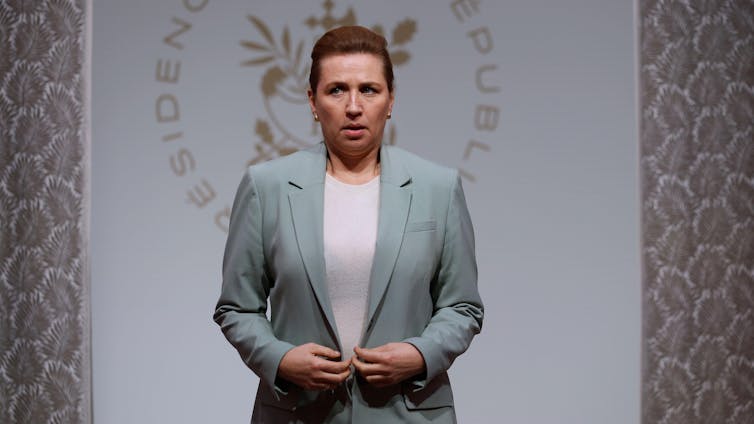 Danish prime minister Mette Frederiksen in Paris on January 6 2026.
Alamy/Yoan Valat
Danish prime minister Mette Frederiksen in Paris on January 6 2026.
Alamy/Yoan Valat
From this perspective it is Greenland’s sustainability and Greenlanders’ lives that must shape the understanding of Denmark’s and other European responses to Trump’s claims. It is through acknowledging the deep relationship that indigenous people have to their ecology that solutions can be found.
And Greenlanders have already expressed their vision for the future. Living on the frontline of the climate crisis, they want an economy built on resilience – not on ego-driven political drama.
While it’s quick and easy to to judge the events in Venezuela or Greenland in terms of the daily news cycle, the four perspectives set out here force people to think for themselves how best to understand complex international crises.
There is, however, a final observation to emphasise. Only one of these perspectives is likely to bring any way of thinking ourselves out of our planetary political crisis.
- Europe
- US politics
- Denmark
- Greenland
- Donald Trump
- Give me perspective
Events
Jobs
-
 Postdoctoral Research Fellow or Research Fellow
-
Research Fellow - AI and Digital Capabilities
-
Data & Reporting Analyst
-
Lecturer/Senior Lecturer, Terrestrial Ecology
-
Video producer
 Postdoctoral Research Fellow or Research Fellow
 Research Fellow - AI and Digital Capabilities
 Data & Reporting Analyst
 Lecturer/Senior Lecturer, Terrestrial Ecology
 Video producer
- Editorial Policies
- Community standards
- Republishing guidelines
- Analytics
- Our feeds
- Get newsletter
- Who we are
- Our charter
- Our team
- Partners and funders
- Resource for media
- Contact us
-
-
-
-
Copyright © 2010–2026, The Conversation