- Home
Edition
Africa Australia Brasil Canada Canada (français) España Europe France Global Indonesia New Zealand United Kingdom United States Edition:
Global
Edition:
Global
- Africa
- Australia
- Brasil
- Canada
- Canada (français)
- España
- Europe
- France
- Indonesia
- New Zealand
- United Kingdom
- United States
Academic rigour, journalistic flair
Dementia at just 24-years-old – how Britain’s youngest sufferer may help researchers understand the disease
Published: January 9, 2026 4.44pm GMT
Rahul Sidhu, University of Sheffield
Author
-
 Rahul Sidhu
PhD Candidate, Neuroscience, University of Sheffield
Disclosure statement
Rahul Sidhu does not work for, consult, own shares in or receive funding from any company or organisation that would benefit from this article, and has disclosed no relevant affiliations beyond their academic appointment.
Partners

University of Sheffield provides funding as a founding partner of The Conversation UK.
View all partners
DOI
https://doi.org/10.64628/AB.qafre6a6t
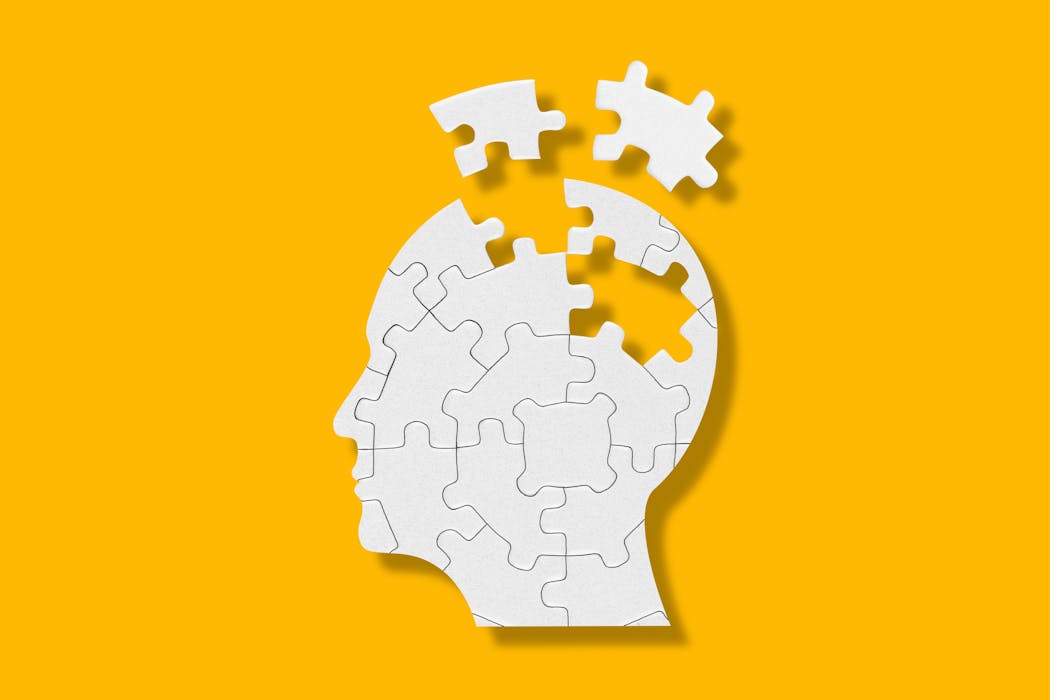
 The family’s decision to donate Yarham’s brain to research will help unlock secrets about frontotemporal dementia.
ahmetmapush/ Shutterstock
https://theconversation.com/dementia-at-just-24-years-old-how-britains-youngest-sufferer-may-help-researchers-understand-the-disease-272972
https://theconversation.com/dementia-at-just-24-years-old-how-britains-youngest-sufferer-may-help-researchers-understand-the-disease-272972
Link copied
Share article
The family’s decision to donate Yarham’s brain to research will help unlock secrets about frontotemporal dementia.
ahmetmapush/ Shutterstock
https://theconversation.com/dementia-at-just-24-years-old-how-britains-youngest-sufferer-may-help-researchers-understand-the-disease-272972
https://theconversation.com/dementia-at-just-24-years-old-how-britains-youngest-sufferer-may-help-researchers-understand-the-disease-272972
Link copied
Share article
Share article
Copy link Email Bluesky Facebook WhatsApp Messenger LinkedIn X (Twitter)Print article
A UK man who is thought to be Britain’s youngest dementia sufferer recently passed away from the disease at only 24 years old. Andre Yarham, from Norfolk in England, was just 22 when he was first diagnosed with dementia.
At the age of 24, most brains are still settling into adulthood. But Yarham’s brain looked decades older — resembling the brain of a 70-year-old, according to the MRI scan that helped diagnose him with the disease.
Yarham initially began exhibiting symptoms of dementia in 2022, with family saying he had become increasingly forgetful and would sometimes have a blank expression on his face.
In the final stages of his life, he lost his speech, could no longer care for himself, behaved “inappropriately” and was bound to his wheelchair.
Dementia is usually associated with old age. However, some forms of dementia can strike astonishingly early and move frighteningly fast. Take frontotemporal dementia, for instance. This was the form of dementia that Yarham was diagnosed with.
Unlike Alzheimer’s disease, which tends to affect memory first, frontotemporal dementia attacks the parts of the brain involved in personality, behaviour and language. These regions sit behind the forehead and above the ears in the frontal and temporal lobes.
These areas help us plan, control impulses, understand speech and express ourselves. When they’re damaged, people may change in ways that are deeply distressing for families – becoming withdrawn, impulsive or unable to communicate.
Frontotemporal dementia is a less common form of dementia, thought to account for around one in 20 cases. What makes it especially cruel is that it can appear in young adulthood.
In many cases, frontotemporal dementia has a strong genetic component. Changes in specific genes can disrupt how brain cells handle proteins. Instead of these proteins being broken down and recycled, they clump together inside the neurons (brain cells) – interfering with their ability to function and survive. Over time, affected brain cells stop working and die. As more cells are lost, the brain tissue itself shrinks.
Why this process can sometimes begin so early in life is still not fully understood. However, when a person has a powerful genetic mutation, the disease does not need decades to unfold. Instead, the mutation allows the damage to accelerate and the brain’s usual resilience fails.
Brain scans carried out while Yarham was alive showed striking shrinkage for someone so young. But to compare Yarham’s brain with that of someone in their 70s would be misleading. His brain had not “aged faster” in the usual sense. Instead, large numbers of neurons had been lost in a short period of time because of the disease.
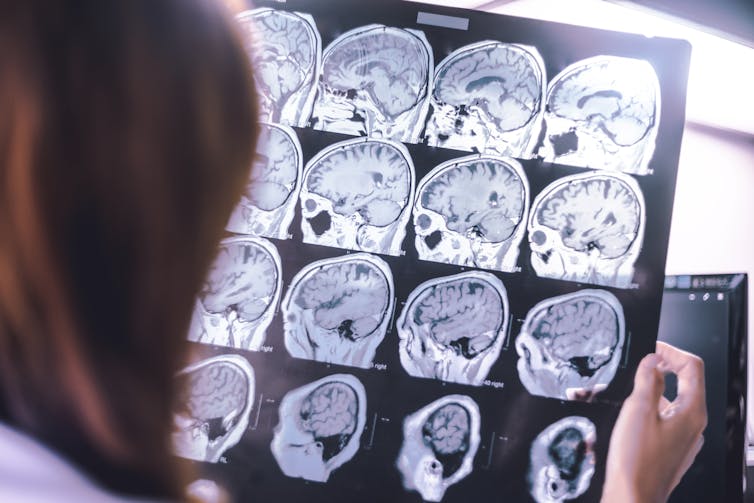 Scans of Yarham’s brain revealed it was decades older than he was.
Atthapon Raksthaput/ Shutterstock
Scans of Yarham’s brain revealed it was decades older than he was.
Atthapon Raksthaput/ Shutterstock
In healthy ageing, the brain changes slowly. Certain regions become a little thinner, but the overall structure remains intact for decades. But in aggressive forms of dementia, whole brain networks collapse at once.
Read more: A 19-year-old is the youngest person to be diagnosed with Alzheimer's disease – the cause is a mystery
In frontotemporal dementia, the frontal and temporal lobes can shrink dramatically. As these regions deteriorate, people lose the abilities that those areas support – including speech, emotional control and decision-making abilities. This would explain why Yarham lost language so late but so suddenly – and why his need for full-time care escalated so quickly.
Brain donation
Yarham’s family decided to donate his brain to research. This is an extraordinary gift – one that transforms tragedy into hope for others.
Dementia currently has no cure. Once symptoms begin, there’s no way to stop them and treatments which slow symptoms have limited effects. Part of the reason for this is because the brain is vastly complex and still not entirely understood. Every donated brain helps close that gap.
Brains affected by very early dementia are exceptionally rare. Each donated brain allows scientists to study, in fine detail, what went wrong at the level of cells and proteins. Although brain scans can tell us what brain parts have been lost, only donated tissue can reveal why.
Researchers can examine which proteins accumulated, which cell types were most vulnerable and how inflammation and immune responses may have contributed to the damage. That knowledge feeds directly into efforts to develop treatments that slow, stop or even prevent dementia.
The family’s decision to allow scientists to study tissue from such a rare, early-onset case of frontotemporal dementia could help unlock secrets that may guide treatments for generations to come.
As a neuroscientist, I have been asked how something like this can happen to someone so young. The honest answer is that we are only beginning to understand the biology that makes some brains vulnerable from the very start.
Cases like this underline why sustained investment in brain research, and the generosity of people willing to donate tissue, matters so deeply. The 24-year-old’s story is a reminder that dementia is not a single disease, and not a problem confined to old age. Understanding why it happened will be one small step toward making sure it does not happen again.
- Dementia
- Organ donation
- Frontotemporal dementia
- Brain research
- Young onset dementia
- Educate me
Events
Jobs
-
 Postdoctoral Research Fellow or Research Fellow
-
Research Fellow - AI and Digital Capabilities
-
Data & Reporting Analyst
-
Lecturer/Senior Lecturer, Terrestrial Ecology
-
Video producer
 Postdoctoral Research Fellow or Research Fellow
 Research Fellow - AI and Digital Capabilities
 Data & Reporting Analyst
 Lecturer/Senior Lecturer, Terrestrial Ecology
 Video producer
- Editorial Policies
- Community standards
- Republishing guidelines
- Analytics
- Our feeds
- Get newsletter
- Who we are
- Our charter
- Our team
- Partners and funders
- Resource for media
- Contact us
-
-
-
-
Copyright © 2010–2026, The Conversation