
- Home
Edition
Africa Australia Brasil Canada Canada (français) España Europe France Global Indonesia New Zealand United Kingdom United States Edition:
Global
Edition:
Global
- Africa
- Australia
- Brasil
- Canada
- Canada (français)
- España
- Europe
- France
- Indonesia
- New Zealand
- United Kingdom
- United States
Academic rigour, journalistic flair
 Kleber Cordeiro/Shutterstock
How to share books with children to help them love reading
Published: January 9, 2026 4.44pm GMT
Jamie Lingwood, Liverpool Hope University, Emma Vardy, Nottingham Trent University
Kleber Cordeiro/Shutterstock
How to share books with children to help them love reading
Published: January 9, 2026 4.44pm GMT
Jamie Lingwood, Liverpool Hope University, Emma Vardy, Nottingham Trent University
Authors
-
 Jamie Lingwood
Senior Lecturer in Psychology, Liverpool Hope University
-
Emma Vardy
Senior Lecturer in Developmental Psychology, Nottingham Trent University
Disclosure statement
Jamie Lingwood receives funding from the Educational Endowment Foundation and Nuffield Foundation.
Emma Vardy receives funding from Education Endowment Foundation.
Partners

Nottingham Trent University and Liverpool Hope University provide funding as members of The Conversation UK.
View all partners
DOI
https://doi.org/10.64628/AB.537fq6ech
https://theconversation.com/how-to-share-books-with-children-to-help-them-love-reading-271023 https://theconversation.com/how-to-share-books-with-children-to-help-them-love-reading-271023 Link copied Share articleShare article
Copy link Email Bluesky Facebook WhatsApp Messenger LinkedIn X (Twitter)Print article
Fewer children in the UK are growing up with a love of books.
Following a survey that showed the proportion of children and young people reading for pleasure has fallen to its lowest level in two decades, the UK government, the National Literacy Trust and other organisations have declared 2026 a national year of reading.
The aim of the campaign is to meet people where they are and encourage them to read about what they’re already interested in. For parents of children – whether they’re reluctant readers or not – a brilliant way to do this is to explore the many ways you can share reading, and your child’s interests, together.
Adults reading together with children from an early age is one of the most effective ways to shield children from the effects of social inequalities, including those linked with childhood disadvantage. For example, reading with young children helps them meet early development milestones and to go on to do better at school.
Children who are read to from an early age tend to learn language faster. These children are also then more likely to go on to develop better vocabularies and become better readers in school.
What’s also vitally important – and often overlooked in favour of the academic benefits of shared reading – is that time spent reading together builds a bond between adults and children, and comes with a wealth of wellbeing benefits for children and adults alike.
A recent report from children’s reading charity The BookTrust emphasises how sharing books fosters early attachment, a dynamic set of expectations and behaviours that stem from the caregiver and how responsive to their child they are.
These early attachments are the fundamental building blocks that lay the groundwork for healthy and happy development. Strong bonds between children and their caregivers are built through calm, consistent and responsive everyday interactions where children feel safe.
When a child shares a book with a parent or carer, this encourages joint attention, helping adults to connect with their child. Reading together is a moment of emotional closeness: parents are tuning into their child’s inner world and responding with warmth, which further strengthens their bond.
The simple, structured activity of sharing a book together encourages the child to develop expectations based on their caregiver’s responsiveness, using them as a secure base, allowing them to explore the world and a safe haven to return to if distressed.
For example, during shared reading a child may point to a picture and say “dog.” Through repeated experiences, the child comes to expect that the adult will notice their focus of attention and respond to them, by immediately and enthusiastically saying, for instance: “That’s right, it’s a black and white dog.” Over time, the child learns that their communicative attempts are valued and will be met with interest and warmth, reinforcing expectations of support and understanding during interactions.
During shared reading, you and your child are in tune. Being present and responsive during reading helps children find the calm in the chaos – as well as you finding this as an adult too.
Making the most of shared reading
When it is time to share a book, create a calm, cosy atmosphere without lots of distractions. Leave digital devices somewhere else, and dim lights or turn on lamps to create soft lighting. Choose a comfy spot: it could be a bed or on the floor with pillows or blankets. At this time the focus is you and your child or children.
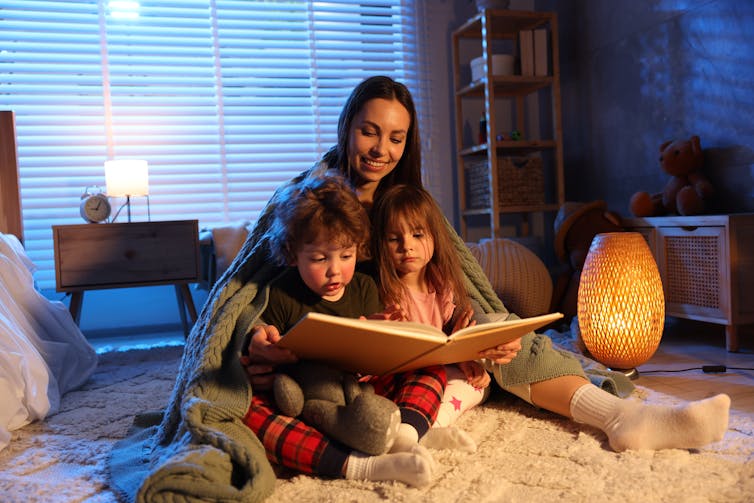 Find a cosy spot to read together.
New Africa/Shutterstock
Find a cosy spot to read together.
New Africa/Shutterstock
Don’t feel compelled to read every word on the page. One of us (Jamie Lingwood) has a two year old son, and doesn’t spend a great deal of time reading the text in the books they share – his son is more interested in flicking through the pictures. It’s OK to just look at the pictures and talk about what you think might be happening in the story. Books are a prop for this shared reading time: use them to start a conversation, storytelling or role play.
As children become older, give them a choice of what to read. One of us (Emma Vardy) has a three year old daughter. Each night she gets a selection of books to pick from, giving her choice over the reading material.
Reading also doesn’t have to mean a book. As the national year of reading campaign encourages, look to what your children are interested in. It could be a comic book, a magazine or a newspaper. You could even create your own book together.
Bedtime is the time we start to all unwind, but shared reading doesn’t need to be at bedtime. It could also be in the morning, if you have an early riser, or sitting at the table sharing lunch.
Shared reading is an opportunity for parents, carers, grandparents, children and communities to rediscover the joy and connection that books can bring.
- Literacy
- Reading
- Shared reading
- Motivate me
Events
Jobs
-
 Postdoctoral Research Fellow or Research Fellow
-
Research Fellow - AI and Digital Capabilities
-
Data & Reporting Analyst
-
Lecturer/Senior Lecturer, Terrestrial Ecology
-
Video producer
 Postdoctoral Research Fellow or Research Fellow
 Research Fellow - AI and Digital Capabilities
 Data & Reporting Analyst
 Lecturer/Senior Lecturer, Terrestrial Ecology
 Video producer
- Editorial Policies
- Community standards
- Republishing guidelines
- Analytics
- Our feeds
- Get newsletter
- Who we are
- Our charter
- Our team
- Partners and funders
- Resource for media
- Contact us
-
-
-
-
Copyright © 2010–2026, The Conversation